
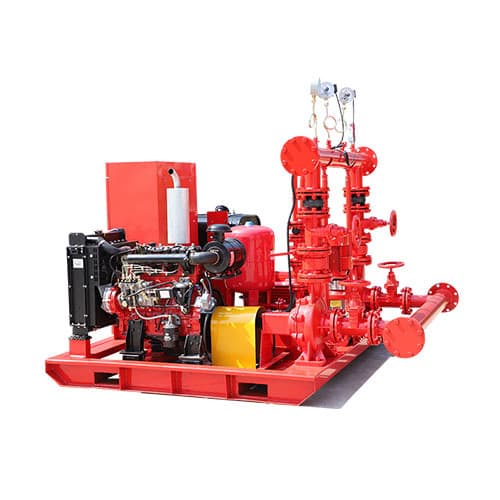
EDJ Fire Pump Set for Data Centers: the short answer
EDJ Fire Pump Set can be evaluated for data center fire protection when the project team first confirms the required fire-water duty, available water source, power conditions and local approval path. The practical question is not whether one generic EDJ fire pump set is suitable for every facility. It is whether the pump, driver, controller and pressure-maintenance arrangement match the approved hydraulic design and the operating conditions of the specific site. This article uses a recent public datacenterdynamics update as a signal that project teams are continuing to plan and build critical facilities. It does not suggest that the source project uses GRIMM PUMP equipment.
Why this industry context matters
datacenterdynamics published an update on 2026-08-07 concerning Container contains transformers, power distribution, UPS, and cooling infrastructure. For an equipment buyer, the useful takeaway is broader than the individual announcement: development activity in data centers usually creates an earlier need to coordinate utility rooms, water storage, electrical infrastructure, access routes and review documents. Fire-water equipment should be considered while these interfaces are still open. A late pump-room decision can create avoidable rework around suction routing, discharge headers, ventilation, drainage, controller access and commissioning responsibility.
The project problem to solve
In data center fire protection, project teams commonly need to reconcile need for electric and diesel duty options; pressure stability between fire events; submittal coordination. Those issues are not solved by a product label alone. The designer or contractor must confirm the required flow and pressure at the duty point, the water-source condition, the available electrical supply, whether a diesel standby arrangement is specified, the pressure-maintenance strategy and the control signals expected by the project. The installation environment also matters: room dimensions, ventilation, drainage, lifting access, vibration controls and maintenance clearance can all affect a workable package arrangement.
How to evaluate the system configuration
Start with the approved hydraulic calculation and project specification. Then compare the required duty with the actual equipment configuration offered. A fire pump package may include a main pump, a driver, controller, base, valves and associated fittings; the exact scope must be confirmed against the project documents. Where a jockey pump is included, its role is pressure maintenance and small leakage compensation. It should not be represented as a replacement for the main fire pump. For EDJ configurations, the electric main pump, diesel standby pump and jockey pump should each be identified in the submittal rather than inferred from a generic drawing.
Selection information that avoids rework
A useful request for quotation includes flow, head, voltage, frequency, motor or engine power, connection size. The buyer should also provide the project country, design standard named in the specification, water-source details, installation location, pipe connection preferences, requested controller functions and required document list. If an approval, certification or performance claim is important to the project, it should be verified against the actual documents available for the quoted configuration. This prevents a sales description from being mistaken for an approved project submittal.
What the product can contribute
An EDJ package combines an electric main pump, a diesel standby pump and a jockey pump for pressure maintenance. In a well-coordinated project, the expected value is clear selection inputs, project-specific configuration support, maintainable equipment layout. GRIMM PUMP can review the supplied selection inputs and prepare a product-oriented technical response, including available drawings, data sheets, performance information or test documents where they apply to the proposed configuration. Final suitability remains subject to the project designer, authority requirements and the approved specification.
A practical review sequence for EPC and contractor teams
First, freeze the hydraulic duty and water-source assumption. Second, identify the required main and standby arrangement without adding a driver that is not part of the approved design. Third, check the pump-room interfaces: suction conditions, discharge routing, controller location, electrical or fuel connections, drainage and service clearances. Fourth, agree the document package before production or shipment. Finally, plan inspection, installation and commissioning responsibilities early enough that the equipment can be tested and handed over with a clear record. This sequence is particularly useful when several contractors share responsibility for the building, utilities and fire-protection scope.
Documents, testing and handover boundaries
A useful technical package is one that identifies what it actually covers. Depending on the quoted equipment and the approved project scope, buyers may request a data sheet, general-arrangement drawing, connection information, controller details, performance information, packing record or available test documentation. Those materials should be checked for the exact model and configuration rather than treated as universal evidence for every variation. During handover, the installer and owner should retain the approved drawings, test records, maintenance instructions and a clear list of responsibility boundaries. This protects the project team from confusing a supplier's product information with site acceptance or authority approval.
Industry example and GRIMM PUMP recommendation
The datacenterdynamics item is an industry example only. It shows why new or expanding facilities can require earlier engineering coordination; it is not evidence of any GRIMM PUMP supply, performance or project involvement. For a data center fire protection enquiry, GRIMM PUMP recommends sending the approved flow and head, pressure units, power details, site location, intended installation arrangement and list of requested documents. That information supports a clearer discussion of configuration options and avoids assumptions about approvals, lead time or system duty.